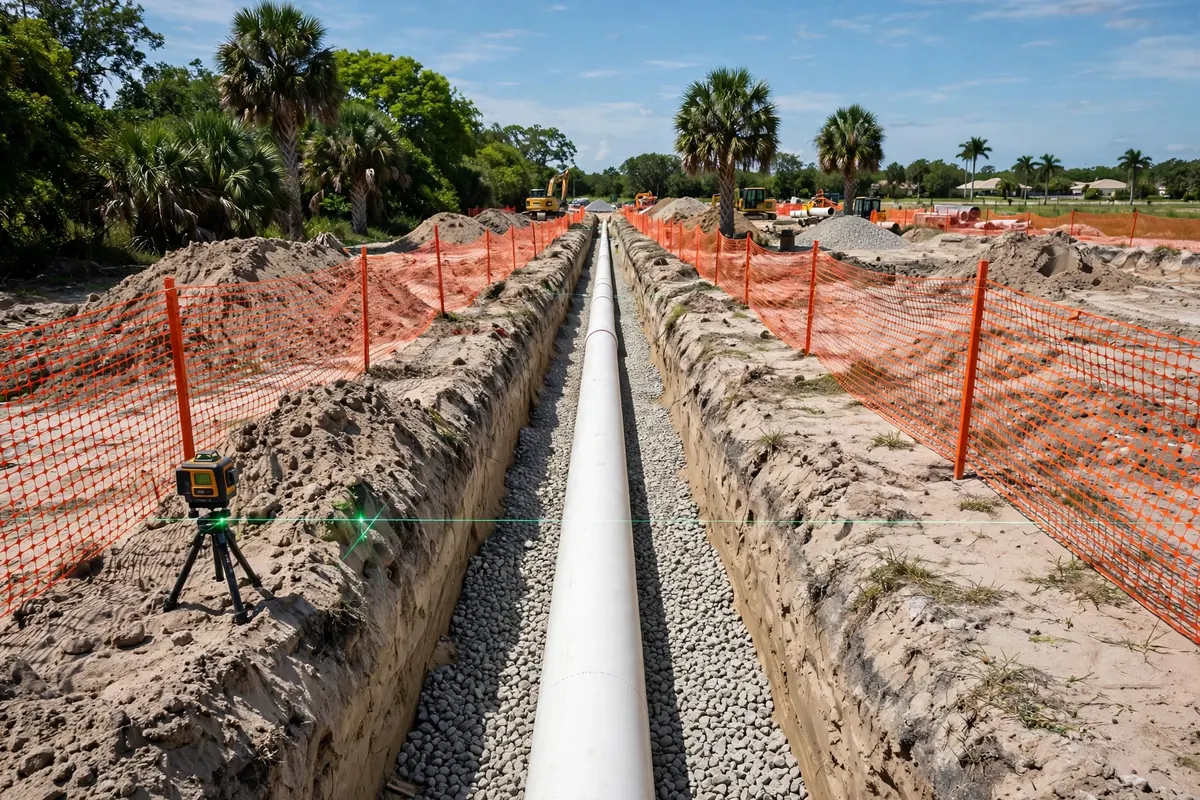
New Pipe for New Space
Sewer installation comes up in a few common situations: new home construction, room additions with new bathrooms, detached garages or workshops with plumbing, accessory dwelling units (ADUs), and pool houses. In every case, the new line has to tie into your existing lateral or the county main — at the right slope, with the right fittings, and with permits pulled.
This is also the service behind septic-to-sewer conversions: when a home connects to county sewer for the first time, the new lateral from house to main is a fresh installation.
How We Install It
- Plan the route. We map the shortest practical path from the new plumbing to the connection point, avoiding trees, structures, and existing utilities. Slope is everything — too flat and waste doesn't flow, too steep and water outruns solids.
- Excavate and bed. The trench gets a properly compacted bedding layer. In our sandy soil, this step is non-negotiable — loose sand backfill is how new lines develop bellies within a year.
- Lay the pipe. Modern PVC, solvent-welded or gasketed joints, laid at a consistent quarter-inch-per-foot slope and checked with a level as we go.
- Connect and test. We tie into the existing system with proper fittings, then test the run before backfilling.
- Backfill in lifts, compact, restore. Compacted layer by layer so the trench doesn't settle into a dip across your yard.
Where the situation allows — an open lot, a straight run — we can also install trenchlessly. Pipe bursting techniques work for new installations too, not just replacements.
Permits and Inspections: We Handle It
New sewer work in Manatee County needs permits and inspections — the county wants to verify slope, materials, and connection points before anything gets buried. We pull the permits, schedule the inspections, and make sure the work passes. It's part of the job, not an extra. Unpermitted sewer work is a nightmare when you sell the house, so we don't skip it and neither should you.
The Slope Conversation Nobody Has With You
Here's what separates a good installation from a future problem: slope. Sewer pipe needs to fall about a quarter inch per foot — enough for water to carry solids along, not so much that water races ahead and leaves solids behind. Too flat is the most common installation mistake, and it creates a permanent maintenance headache: a line that needs jetting forever because it was laid wrong on day one.
We check slope continuously during installation, not just at the end. And in Bradenton's sandy soil, we over-attend to bedding and compaction, because sand settles — and a settled line is a bellied line. Getting this right on installation day is infinitely cheaper than fixing it later.