Your Pipe Might Not Be Dead Yet
When a Bradenton homeowner with a 1960s ranch hears "your cast iron is scaled," the assumption is usually that replacement is the only option. Not always. Scale is buildup on the inside walls — ugly, flow-choking, but often sitting on top of pipe walls that are still structurally sound underneath.
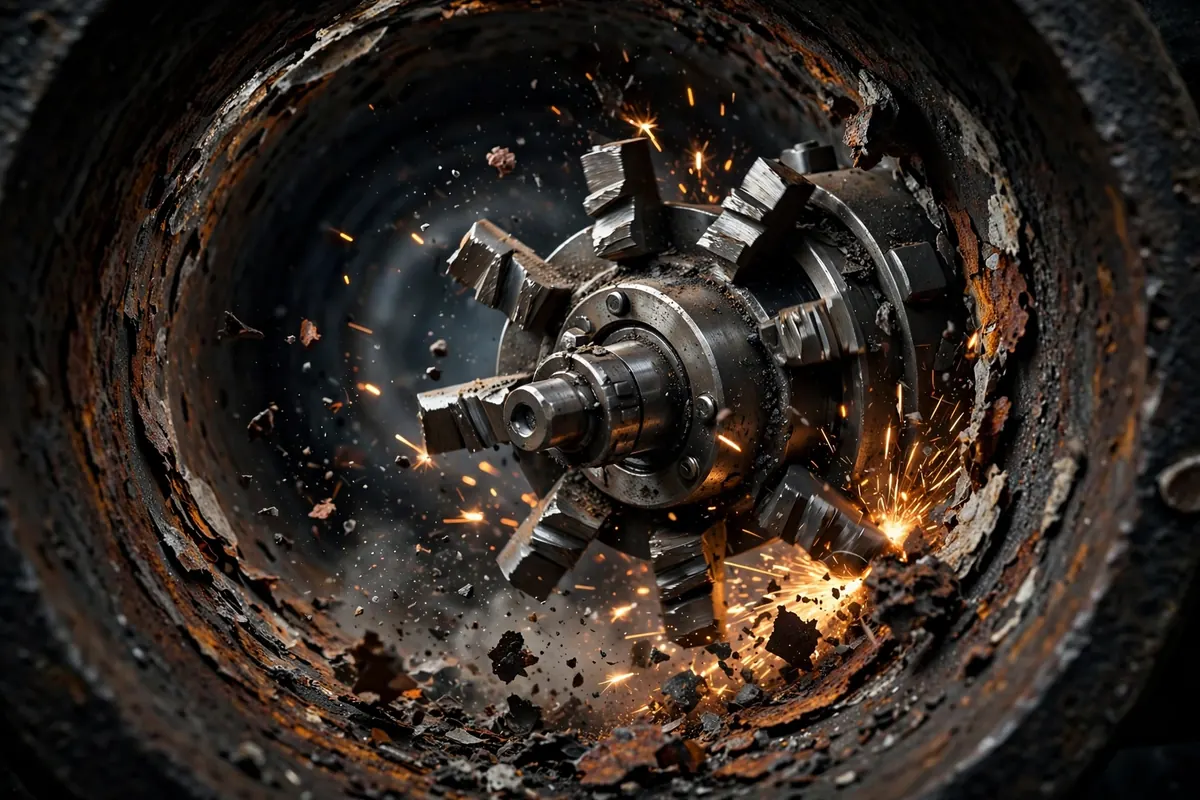
Descaling removes the buildup mechanically: spinning chains or milling heads travel through the pipe, flailing and grinding the scale off the walls, and hydro jetting flushes it all out. What comes out looks like rust-colored gravel. What stays behind is your original pipe — with its full diameter restored.
How Milling Works
- Camera first. We need to see wall condition under the scale. Descaling only makes sense if the pipe is sound beneath the buildup — if the walls are corroded through, cleaning just exposes the damage. (That's a replacement conversation.)
- Chain flailing. Specialized chains spin at high speed inside the pipe, shattering scale off the walls. For heavy buildup, carbide milling heads grind it down progressively.
- Jet and flush. High-pressure water flushes every loosened particle downstream and out.
- Verify on camera. The after footage is striking — rough, narrowed pipe becomes smooth, full-diameter pipe again.
Most residential descaling jobs are done in a day, through existing access points. No digging.
Descaling vs. Replacement: The Honest Line
This is the decision that matters, so let's be precise. Descale when: the camera shows heavy scale but the pipe walls are intact — no through-wall corrosion, no channeling along the bottom, no cracks or breaks. The pipe has years of structural life left; it just can't flow.
Replace when: the scale is hiding thin walls, the bottom is channeled out, or there are cracks and breaks. Descaling a dying pipe is polishing a rotten apple — you'll pay for the cleaning and still need the replacement.
We'll show you the camera footage and tell you which side of the line you're on. Sometimes the answer is descale now and line later — descaling followed by CIPP lining is a powerful combination: clean pipe, then a brand-new pipe inside it, all without digging.
Why Bradenton's Cast Iron Scales So Aggressively
Our water, our soil, and time. Florida's mineral content contributes to internal buildup, the humid environment and high water table keep old iron perpetually damp (corrosion loves moisture), and 50 to 70 years is simply a long time for iron to sit underground. The 1950s–60s homes in Bayshore Gardens, west Bradenton, and Palmetto are hitting the peak scaling years right now — which is exactly why descaling is worth evaluating before assuming replacement.