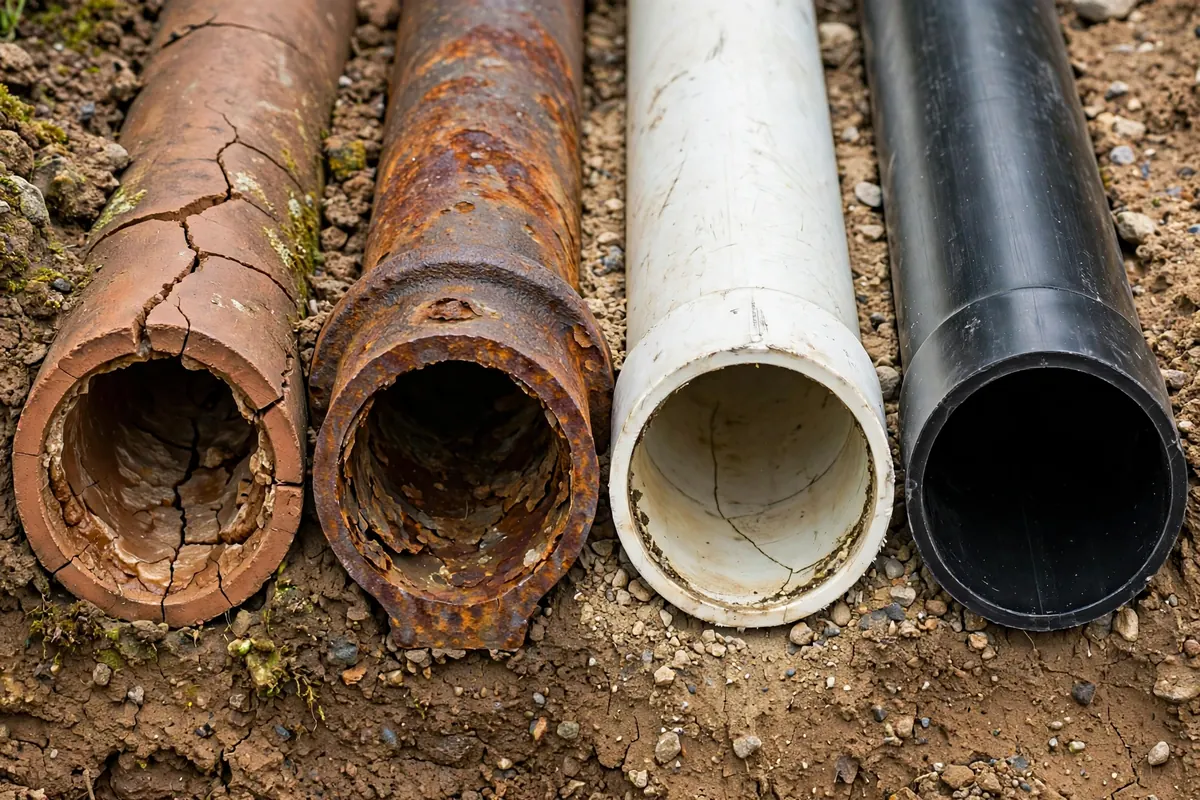
Clay / Terracotta Tile: 50–60 Years (Often Less Here)
The workhorse of mid-century Florida plumbing. Clay tile comes in short segments joined with mortar or rubber gaskets, and those joints are the whole story. Each joint is a potential entry point for roots and a potential offset point when soil shifts.
In Bradenton's sandy soil, clay laterals face a double threat: joints that separate as ground settles, and live oak roots that find every gap. A clay line installed in a Bayshore Gardens ranch in 1958 is now pushing 70 years old — well past its design life. Some are still working; many are held together by roots that have become structural. If your home was built before 1970 and never had its lateral replaced, assume clay until a camera proves otherwise.
Cast Iron: 50–75 Years, But Florida Is Hard on It
Cast iron is strong — it handles soil loads beautifully — but it rusts from the inside out. Wastewater is corrosive, and decades of flow eat the pipe wall while mineral scale builds up on top of the corrosion. The result is a pipe that looks intact from outside while its interior narrows year by year.
Florida's warm wastewater and high water table accelerate the chemistry. Cast iron laterals in 1950s–70s Bradenton homes are the classic "still working but living on borrowed time" scenario. The good news: cast iron that's structurally sound but scaled up can often be descaled and lined rather than replaced — it's one of the best candidates for rehabilitation. The bad news: once it's rusted through in spots, patching buys little time.
Orangeburg: 30–50 Years (If You Have It, Plan Ahead)
Orangeburg — bituminized fiber pipe, basically tar-soaked paper — was used in some homes from the 1940s through the 1970s as a cheap alternative to clay or iron. It was never meant to last. It deforms under soil pressure, blisters from the inside, and eventually collapses into an oval and then nothing.
Any Orangeburg still in the ground in Manatee County is past its expiration date by definition. It can't be lined (there's no structure to hold a liner) and it can't be trusted. If a camera inspection finds Orangeburg, start planning a replacement — pipe bursting is often ideal since it replaces the line without a full trench.
PVC: 75–100+ Years (The Modern Standard)
PVC is what everything's been built with since roughly the 1980s, and it's the reason newer homes rarely have lateral drama. It's seamless over long runs (fewer joints), immune to rust and root chemistry, and smooth inside so waste doesn't cling. A properly installed PVC lateral should outlive its installer.
"Properly installed" does real work in that sentence. In Florida's sand, poor bedding and compaction let PVC develop bellies — sags where solids settle. New construction in fast-growing areas like Lakewood Ranch occasionally produces bellied PVC within years, not decades. The pipe material is fine; the installation is the variable. PVC also doesn't love concentrated chemical drain cleaners (more on that in our drain cleaner post) — the heat they generate can soften it.
Concrete and HDPE: The Others
Concrete pipe shows up in larger municipal mains more than residential laterals. It lasts 50–75 years but suffers in acidic soils and hydrogen sulfide environments — relevant to municipal systems, less so to your lateral.
HDPE (high-density polyethylene) is the modern trenchless replacement pipe — it's what gets pulled in during pipe bursting. Flexible, fused joints (essentially one continuous pipe), 50–100+ year lifespan. When your old line gets replaced today, this is likely what replaces it.
What Actually Determines Your Line's Remaining Life
Material sets the range; conditions set the reality. Five things matter more than the calendar:
- Soil movement. Sandy soil that shifts and settles stresses joints and creates bellies. The most common Florida-specific lifespan killer.
- Root pressure. A lateral running under mature live oaks ages faster than the same pipe in an open lawn. Roots exploit every weakness.
- Installation quality. Proper bedding, correct slope, solid joints — a well-installed clay line can outlast a poorly installed PVC one.
- What's been flushed. Grease, wipes, and chemicals punish pipes daily. (See our never-flush list.)
- Water table. Pipes sitting in groundwater face infiltration at every joint and faster exterior corrosion of metal pipe.
The honest way to know where your line stands: a camera inspection. Age and material tell you the odds; the camera tells you the truth. A 65-year-old clay lateral in perfect condition exists. So does a 15-year-old PVC line with a belly from bad compaction. Don't guess from the calendar — look.
Reading Your Pipe's Age From Your Bradenton Neighborhood
You can make a good guess about your lateral before any camera goes in, just from local housing history:
- 1920s–1940s (Village of the Arts cottages, Cortez fishing village core, Palmetto historic district): likely clay tile, possibly with original mortar joints. If never replaced, these are the oldest working laterals in the county — respect their age.
- 1950s–1960s (Bayshore Gardens, Samoset, West Bradenton ranches): clay tile or cast iron, now 60–70 years old. The highest-risk cohort in Manatee County — huge numbers of these laterals are at or past end of life right now.
- 1970s–1980s (South Bradenton condos, Oneco subdivisions): transitional era — cast iron, early PVC, sometimes both in one lateral. Better odds, but 40–50 years is enough for cast iron to be significantly corroded.
- 1990s–2000s (early Lakewood Ranch, Parrish subdivisions): predominantly PVC. Material should be fine; installation quality (compaction, grade) is the variable to check.
- 2010s–present (new Lakewood Ranch villages, North River Ranch): PVC or HDPE, modern standards. Lowest risk — but a baseline inspection still isn't a bad idea.
These are probabilities, not certainties. Renovations, partial replacements, and individual builder choices all create exceptions. But if your home falls in the 1950s–60s cohort and you've never had the lateral inspected, you're sitting on the county's most failure-prone pipe population. That's not alarmism — it's arithmetic.
Extending the Life You've Got
You can't make a 65-year-old clay pipe young again, but you can keep it working longer:
- Keep roots managed. Regular root treatment (mechanical clearing on a schedule, not just when it clogs) prevents the root mass from exerting structural force on joints. It's maintenance, not a cure — but it buys years.
- Watch what goes down. Grease, wipes, and chemicals age pipes faster. Every item on our never-flush list is a small deposit on your pipe's remaining lifespan.
- Fix small problems early. A single offset joint caught early is a spot repair. The same joint, ignored for five years while roots and soil movement work on it, becomes a collapsed section needing full replacement.
- Consider rehabilitation before failure. Lining a deteriorated-but-intact pipe, or descaling scaled cast iron, resets the clock at a fraction of replacement cost — but only while the pipe still qualifies. Waiting until it collapses removes the option.
- Inspect periodically. Every 2–3 years for older lines, or annually if you have known issues under management. The camera is how you catch the transition from "aging" to "failing" in time to choose your response.
Pipes don't last forever. But the difference between a lateral that fails at 55 and one that serves to 75 is almost entirely maintenance and attention. The pipe can't ask for it — you have to offer.
Need help with your sewer line?
We serve Bradenton and all of Manatee County. A camera inspection is the fastest way to know what's going on.
Call (941) 214-9486