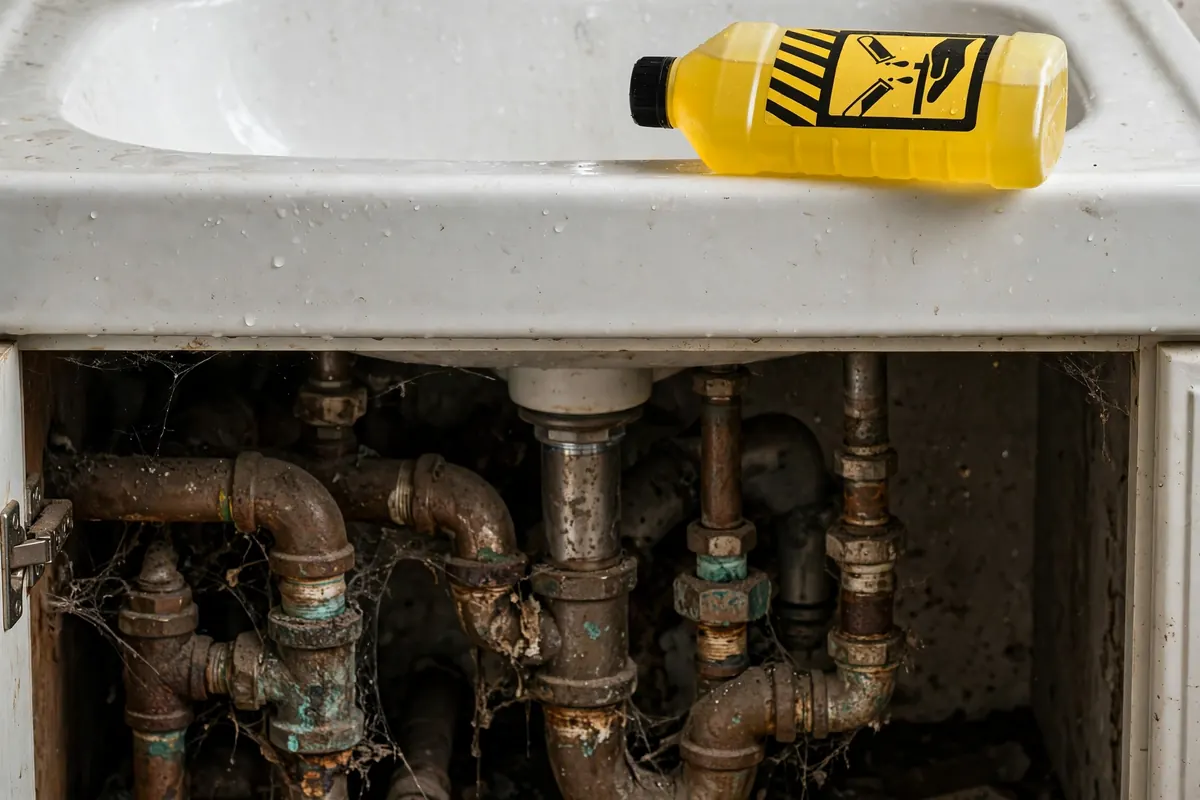
What's Actually in the Bottle
Most chemical drain cleaners fall into two families. Caustic cleaners (the common gel and powder types) use sodium hydroxide — lye — sometimes with sodium hypochlorite (bleach). They work by generating heat and chemically breaking down organic matter. Acid cleaners (usually sulfuric acid, sold to professionals and sometimes consumers) are far more aggressive — they char and dissolve organic material on contact.
Both work through the same basic mechanism: a violent chemical reaction inside your pipe. That violence is the product. It's also the problem.
What the Reaction Does to Your Pipes
The heat is the main villain. Caustic cleaners can raise the temperature inside a pipe dramatically — and heat softens PVC. A single use on a new PVC line probably won't destroy it, but repeated use, or use on older or thinner pipe, can warp joints and weaken connections. On a partially blocked line, the chemical sits in one spot, concentrating the heat exactly where the pipe is already stressed.
On metal pipes, the chemistry is different but not kinder. Caustic solutions accelerate corrosion in already-aging cast iron and galvanized pipe. Acid cleaners are worse — they attack metal directly. Pouring acid into a 60-year-old cast iron lateral is asking a corroding pipe to survive a chemical attack. Sometimes it doesn't.
Rubber gaskets, wax toilet seals, and the rubber couplings common in older Florida plumbing are also vulnerable. Chemical damage to a $3 gasket can create a leak that costs hundreds to access and fix.
Why They Usually Don't Fix the Real Problem
Here's the fundamental mismatch: chemical cleaners dissolve soft organic clogs — hair, soap scum, grease near the drain. But the clogs that actually plague sewer lines are things chemistry can't touch:
- Tree roots. Lye doesn't kill a root mass. It might burn the outer layer; the root system shrugs and continues.
- Pipe bellies. No chemical corrects lost grade. The solids will just accumulate again.
- Offset joints and collapsed sections. Chemistry can't reassemble a broken pipe.
- Scale buildup in cast iron. Mineral scale laughs at drain cleaner.
- "Flushable" wipes and solid obstructions. They don't dissolve in any reasonable timeframe.
So the cleaner fails to clear the line — and now you have a pipe full of caustic chemical sitting on top of the blockage. Which brings us to the part plumbers care about most.
The Hazard You Create for the Next Person
When the bottle fails (and for real sewer problems, it usually does), the next step is calling a plumber — who now has to work on a line full of caustic chemical. Drain cleaning equipment, camera heads, and hands all go into that. Chemical burns are a genuine occupational hazard, and most plumbers will tell you: please tell us if you used a chemical cleaner before we open the line.
This isn't a guilt trip — it's practical. If you've used a chemical product and it didn't work, say so upfront when you call. It changes how the work gets done and keeps everyone safe.
What to Use Instead
For a slow bathroom sink or tub: a plunger, then a drain snake (a $25 hand auger handles most minor clogs). For kitchen sinks: boiling water and dish soap for grease, mechanically — no chemicals needed. For a garbage disposal jam: the reset button and an Allen wrench, not a bottle.
For recurring clogs, whole-house slowdowns, or anything involving the main line: skip the DIY entirely and get professional drain cleaning. A plumber with a proper auger or hydro jetter clears in minutes what chemicals can't clear in a week — without the pipe damage and without the hazard.
And for the chronic stuff — the drain that clogs every few months no matter what — stop treating the symptom. Get a camera inspection. The bottle was never going to fix roots, bellies, or broken pipe. Seeing the actual problem is what ends the cycle.
The One Exception (and Its Limits)
Enzyme-based drain maintainers — the bacterial kind, not the caustic kind — are a different category. They don't generate heat or attack pipes; they introduce bacteria that digest organic buildup slowly over time. They're reasonable as maintenance on a healthy line (monthly use in a kitchen drain, say). They will not clear an existing clog, kill roots, or fix anything structural. Think of them as vitamins, not medicine.
The Marketing vs. the Chemistry
Watch a drain cleaner commercial: the clog dissolves in seconds, water flows freely, everyone smiles. Now read the back label: warnings about burns, ventilation, protective gear, and keeping it away from children. Both are telling the truth — the product is genuinely violent chemistry, which is exactly why it's genuinely hazardous.
A few label claims decoded:
- "Dissolves hair and grease." True — in a laboratory beaker. In your pipe, it must first reach the clog through standing water (diluting it), then work through the blockage from one side, all while the clock runs on pipe damage. Real-world performance is a fraction of the demo.
- "Safe for all pipes." The most creative sentence in advertising. Safe under ideal conditions, briefly, in intact modern pipe — with a long list of exceptions in the fine print. Your 1960s cast iron lateral is not the ideal condition.
- "Professional strength." Means concentrated — which means more heat, more hazard, and more damage potential. Professionals who actually use acid cleaners do so with training, protective equipment, and full knowledge of the pipe they're treating. The bottle doesn't include any of that.
The product isn't a scam — it's a harsh chemical doing harsh chemistry. The scam is the implication that harsh chemistry is what your pipes need. Usually, what they need is mechanical clearing and a camera.
Septic Systems: Why Chemicals Are Worse There
If your home is on septic — common in Myakka City, rural Parrish, and parts of Palmetto's Snead Island — chemical drain cleaners do double damage. Beyond the pipe risks above, they kill the beneficial bacteria your septic tank depends on to break down waste. A healthy tank is a living ecosystem; pouring lye or bleach into it is an extinction event.
A bacteria-depleted tank stops digesting solids, which then flow out to the drain field and clog it — turning a $10 bottle of drain cleaner into a five-figure drain field replacement. Septic professionals are unanimous on this: never use chemical cleaners on a septic system. Mechanical methods only, and pump the tank on schedule.
Considering leaving septic behind entirely? Our septic-to-sewer conversion service covers what's involved in connecting to county sewer where it's available.
What Your Plumber Wishes You Knew
Ask any plumber about chemical drain cleaners and you'll get the same weary look. Not because they want your service call — a $15 bottle versus a $200 visit is a real price difference, and they know it. The frustration is that the bottle so often makes things worse: the chemical fails to clear the real blockage, damages the pipe in the attempt, and creates a hazardous work environment for whoever comes next.
The plumber's actual wish list is short: try the plunger, try the hand snake, and when those don't work — or when the problem keeps coming back — call before the situation escalates. A drain cleared mechanically on the first visit costs less than a drain cleared chemically three times and then mechanically anyway, with pipe damage as a bonus. The bottle feels like saving money. Most of the time, it's just deferring the bill and adding interest.
Need help with your sewer line?
We serve Bradenton and all of Manatee County. A camera inspection is the fastest way to know what's going on.
Call (941) 214-9486