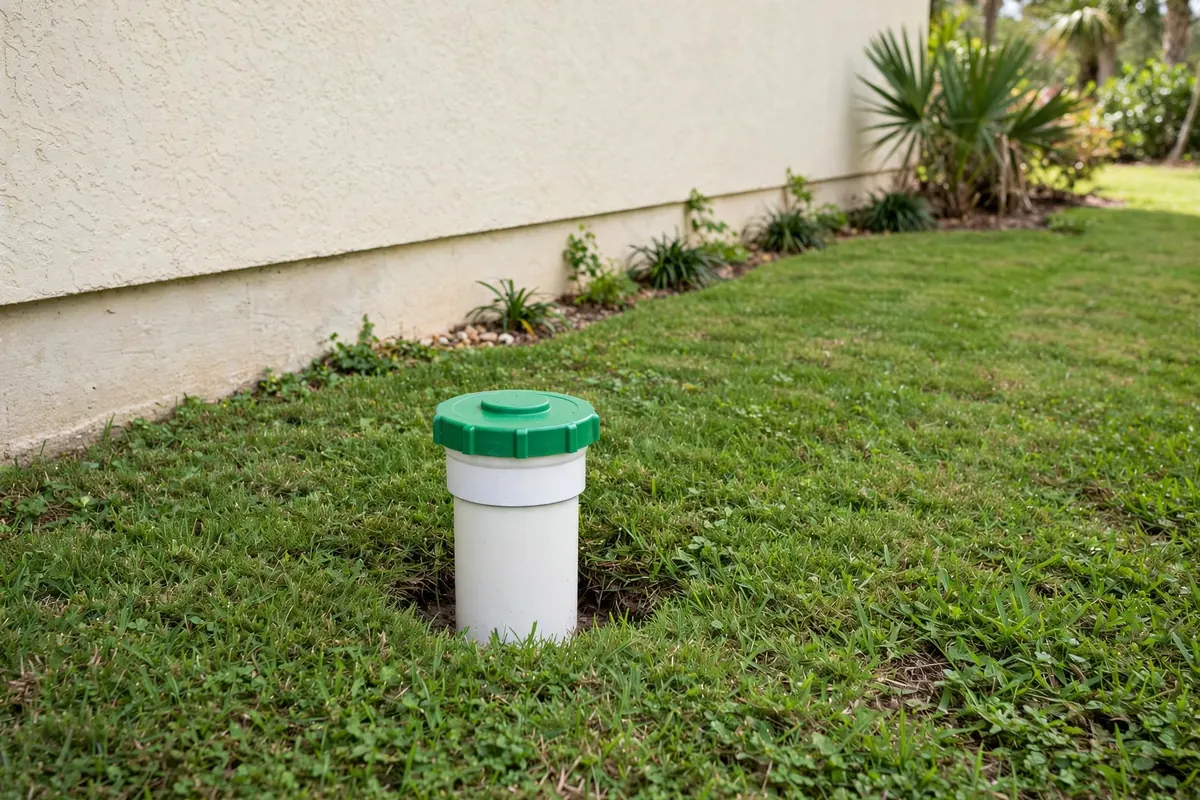
The Access Panel Your House Might Be Missing
Think of a cleanout like the access panel on any other system in your house. Your electrical panel gives an electrician direct access to your wiring. A sewer cleanout gives a plumber direct access to your line — a straight shot in with a camera, a snake, or a jetter hose.
Many of Bradenton's 1950s–70s homes were built without one, or with one that's been buried under landscaping for decades. Every sewer job on those houses starts with an awkward workaround: pulling a toilet (messy, slow, risks breaking the seal) or feeding equipment down a roof vent (awkward angles, limited reach). A proper cleanout eliminates all of that.
How Installation Works
- Locate the line. We find your sewer lateral's path and pick the best spot — usually near the house foundation or at the property line, somewhere accessible but out of the way.
- Dig down. One small excavation to expose the line. No trench.
- Cut in a tee. We cut the existing line and install a sanitary tee with a riser pipe brought up to grade.
- Cap and mark. A watertight cap sits flush or just above grade, protected by a valve box so the mower doesn't eat it. We show you exactly where it is.
Most installations are done in half a day. If we're already on-site for a camera inspection or a repair, adding the cleanout then is the most economical way to do it.
Why It Pays for Itself
A cleanout doesn't fix anything by itself. What it does is make every future sewer visit dramatically simpler. Camera inspections take minutes instead of an hour of setup. Drain cleaning goes straight in instead of through your bathroom. Emergency clogs get cleared faster — which matters a lot when sewage is backing up and every minute counts.
It also protects your home. Pulling a toilet to access the line means breaking and remaking the wax seal, with a real risk of a leak afterward. Roof vent access means dragging equipment through your house. A yard cleanout keeps all of that outside where it belongs.
Two Cleanouts Are Better Than One
The ideal setup is two: one near the house (so we can work the line toward the street) and one near the property line or sidewalk (so we can work back toward the house). Two-way access means a camera or snake can reach every inch of the lateral from one side or the other, with no blind spots.
If your home has no cleanout at all, start with one near the house — it covers the most common needs. We can add the second later, or during any larger sewer project when we're already digging.