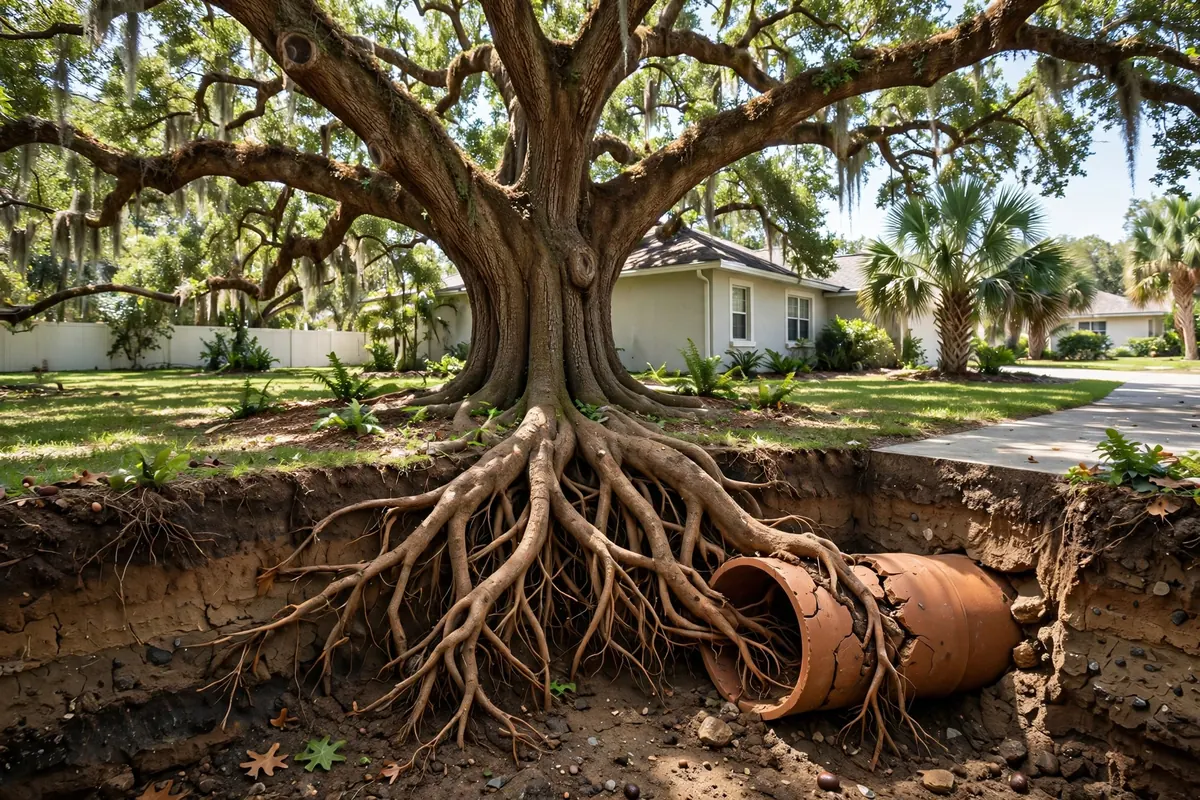
How Roots Find Your Pipe in the First Place
Tree roots don't "seek" pipes the way animals seek food — they follow moisture gradients. Fine root hairs grow toward water vapor, and a sewer lateral leaking even tiny amounts of moisture through a cracked joint creates a vapor plume in the surrounding soil. Roots follow the gradient to the source. Botanists call it hydrotropism, and it's extraordinarily sensitive — roots can detect moisture differences you'd never notice.
Once a root hair reaches the pipe, it enters through any opening: a cracked clay joint, an offset, a deteriorated rubber gasket. Inside the pipe is paradise — constant moisture, constant nutrients, no competition. The root branches prolifically. What started as a hair becomes a mass.
Live oaks, the signature tree of Manatee County's older neighborhoods, are particularly aggressive. Their root systems are wide, opportunistic, and relentless. A mature live oak's roots can extend two to three times the canopy's diameter — which means the tree three houses down can be in your lateral.
Why Cutting Them Doesn't End It
Here's the part that frustrates homeowners: mechanical root cutting — the spinning blades that clear the line — is pruning, not killing. When you prune a tree's branches, it responds by growing more branches. Roots do exactly the same thing underground.
Cut a root inside a pipe and the tree responds at the cut point by pushing out multiple new feeder roots — often finer, more numerous, and more aggressive than the original. This is called reiteration, and it's why the second clog sometimes forms faster than the first. You didn't just fail to solve the problem; the "solution" stimulated the tree to try harder.
Chemical root treatments (copper sulfate, foaming herbicides) kill the roots currently in the pipe, but they don't seal the entry point and they don't discourage the tree. The opening is still there. The moisture gradient is still there. New roots arrive within months to a couple of years, depending on the tree's vigor and the pipe's condition.
The Real Problem Is the Opening, Not the Root
This is the mental shift that matters: roots are a symptom. The disease is the defective pipe. A perfectly intact, jointless pipe is essentially root-proof — there is no opening to enter and no moisture escaping to attract them. Roots only become a sewer problem when the pipe gives them a way in.
That's why root problems cluster in predictable places: clay tile laterals with a joint every three feet (dozens of potential entries), cast iron with corroded-through spots, any pipe with offset joints from soil movement. And it's why the same homes need clearing every 12–18 months like clockwork — the pipe's defects are permanent, so the reinvasion is permanent.
Every root clearing without addressing the pipe is renting relief. The tree has decades; your cleared pipe has months.
What Actually Breaks the Cycle
There are exactly two ways to stop roots permanently: remove the openings, or remove the tree's access to the pipe zone. In practice:
- Seal the pipe. Trenchless lining creates a seamless pipe-within-a-pipe — no joints, no cracks, no entries. Roots can't enter what has no openings, and a sealed pipe stops leaking the moisture vapor that attracts them. This is the definitive fix for root-prone laterals and the reason lining is so popular in oak-heavy neighborhoods.
- Replace the pipe. Pipe bursting or traditional replacement with fused-joint HDPE or properly joined PVC eliminates the defects entirely. New pipe, no entries, problem solved for decades.
- Remove the tree. Sometimes the honest answer, especially for a fast-growing species planted directly over the lateral. But it's often unnecessary if the pipe itself is fixed — and removing a heritage live oak to save a clay pipe is backwards priorities. Fix the pipe; keep the tree.
What doesn't break the cycle: repeated cutting (pruning stimulates regrowth), chemical treatments alone (kills current roots, leaves the door open), and "root barriers" installed after the fact (they redirect some roots but rarely all, and they don't fix the pipe).
The Math That Should Drive Your Decision
Add up what recurring clearing costs you — not just the service calls, but the slow drains between them, the emergency backup risk, the Saturday mornings waiting for the truck. Then compare it once against a permanent fix. Most homeowners who've paid for three or four clearings have spent enough to have solved it permanently the first time.
The rule of thumb: if you're clearing roots more than once every couple of years, stop renting and buy the fix. Get a camera inspection, see exactly where the entries are, and price the permanent solution. The tree isn't going anywhere. Make sure your pipe can say the same.
Which Pipes Are Most Vulnerable (Ranked)
Not all pipes invite roots equally. From most to least vulnerable:
- Clay tile with mortar joints. A joint every 3–4 feet, each one a potential entry. The undisputed champion of root problems — which is why so many 1950s–60s Bradenton homes are on the clearing treadmill.
- Cast iron with corrosion. Fewer joints, but rust-through spots become entries. Older cast iron in root zones is a close second.
- Orangeburg. Deforms and blisters, creating entries everywhere. (Though if you have Orangeburg, roots are the least of your worries — replacement is overdue regardless.)
- PVC with bad joints. The material is root-resistant, but poorly glued or offset joints are entries like any other. Installation quality is everything.
- Properly installed PVC or HDPE. Long runs, fused or properly sealed joints, no entries. Roots can press against it all they want — there's nowhere to go in.
- Cured-in-place liner. Seamless and jointless. The gold standard for root exclusion in an existing line.
Notice the pattern: it's never really about the tree. It's always about the pipe. Two houses with the same oak, different laterals — one has root problems forever, the other never does.
Landscaping Smart: What to Plant Near Sewer Lines
If you're planting new trees, keep them away from the lateral — and know where the lateral is before you dig (call 811; it's free and it's the law). As rough guidance:
- Highest risk near pipes: live oaks, ficus, willows, elms — large, aggressive, thirsty root systems. Beautiful trees; plant them far from underground utilities.
- Moderate risk: most medium shade trees. Fine at 20+ feet from the line.
- Lower risk: small ornamental trees, palms (fibrous rather than woody roots, less pipe-penetrating), shrubs and garden beds over the line route.
For existing mature trees near your lateral: don't preemptively remove a heritage oak out of pipe anxiety. Instead, know your pipe's condition — a sound PVC or lined lateral coexists fine with big trees. It's the defective pipe plus the tree that's the problem. Fix the pipe, keep the tree, everybody wins.
The Question to Ask Your Contractor
When you're getting quotes for root problems, there's one question that separates the order-takers from the problem-solvers: "What's your plan to stop them coming back?"
If the answer is "we'll clear them again when they return," you're talking to someone selling a subscription, not a solution. The right answer references your camera footage, identifies the entry points, and proposes eliminating them — lining, bursting, or targeted replacement of the defective sections. Clearing has its place as immediate relief or as maintenance on a line you're monitoring. But it should never be presented as the fix. You now know the biology. Make sure your contractor does too.
Need help with your sewer line?
We serve Bradenton and all of Manatee County. A camera inspection is the fastest way to know what's going on.
Call (941) 214-9486