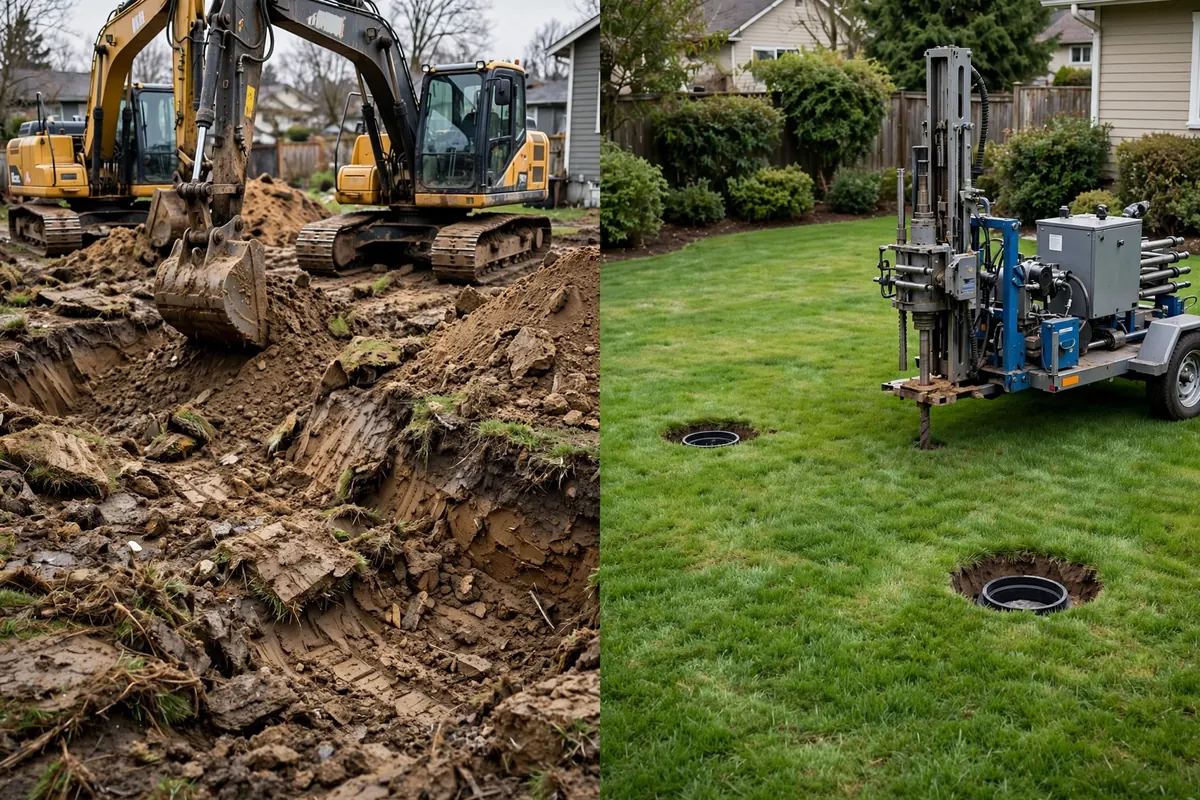
What "Traditional" Repair Actually Means
Traditional — also called open-trench or dig-and-replace — is the original method. The crew locates the damaged pipe, digs a trench along its full length, pulls out the old pipe, lays new pipe, backfills, and restores the surface. It's straightforward, it's been done for a century, and when the pipe is truly destroyed, it's sometimes the only option.
The obvious cost is the digging. The less obvious cost is everything the digging touches: driveways, sidewalks, patios, landscaping, irrigation lines, and occasionally the roots of trees you'd rather keep. Restoration is a separate project with a separate price tag, and it's where traditional quotes have a habit of growing.
What "Trenchless" Actually Covers
Trenchless isn't one method — it's a family of no-dig (or minimal-dig) techniques. The two main ones:
- Pipe lining (CIPP). A resin-soaked liner is inserted into the old pipe and cured in place, forming a new pipe inside the old one. Needs only small access points. Best for pipes that are cracked or root-damaged but still structurally holding their shape.
- Pipe bursting. A bursting head is pulled through the old pipe, fracturing it outward, while a brand-new pipe follows right behind. Needs entry and exit pits. Best when the old pipe is too far gone to line but the route is still viable.
Both avoid the long open trench. Both leave your yard mostly intact. Neither is magic — they have real limitations, which we'll get to.
Where Trenchless Genuinely Wins
Start with the obvious: your property stays in one piece. In Bradenton neighborhoods with mature live oaks, elaborate landscaping, paver driveways, or pool decks sitting over the lateral, avoiding excavation isn't cosmetic — it's the difference between a one-week project and a month of restoration contractors.
Speed is real too. A lining job often finishes in a day; pipe bursting in one to two. A full traditional replacement can run several days to a week, plus restoration time. If you work from home or run a business on the property, fewer days of torn-up ground matters.
There's also a structural argument. A cured-in-place liner is seamless — no joints for roots to exploit. In areas with aggressive root pressure (and Manatee County's live oaks are nothing if not aggressive), a jointless pipe is a genuine long-term advantage.
Where Traditional Genuinely Wins
Now the other side, because trenchless marketing tends to skip it. Traditional excavation wins whenever the pipe's geometry is the problem, not just its condition. A pipe with a severe belly — a sagging low spot where waste pools — can't be fixed by lining the inside of the sag. The grade has to be corrected, and that means digging. Same for a line that's collapsed flat, or one that's back-pitched (sloping the wrong way).
Digging also lets the crew see everything. They can correct depth, fix bad connections, replace undersized pipe with larger diameter, and verify the bedding underneath. Trenchless works with the line you've got; traditional lets you build the line you wish you had.
And sometimes traditional is simply cheaper for short, shallow, easily accessed runs — say, a 15-foot section under an open lawn with no obstacles. Digging a small hole in grass is fast and cheap. Lining equipment has mobilization costs that don't scale down for tiny jobs.
The Honest Limitations Nobody Puts in the Brochure
Trenchless lining can't fix a pipe that's lost its shape — collapsed sections, major offsets, or severe bellies need excavation. Liners also slightly reduce the pipe's inner diameter, which matters in already-undersized lines. And lining requires a host pipe with enough integrity to hold the liner during curing; if the old pipe is rubble, there's nothing to line.
Pipe bursting needs room for entry and exit pits, and it can't navigate sharp bends or lines with certain types of connections. It also displaces soil outward, which can be a concern near other utilities — a good contractor locates everything first, but it's a real planning constraint.
Traditional's limitations are mostly about disruption and restoration cost, plus weather: an open trench in a Florida downpour is a miserable, sometimes dangerous, worksite. Summer storm season can stall dig projects in ways that trenchless mostly avoids.
How to Decide for Your Property
The decision tree is simpler than the marketing makes it look:
- Get a camera inspection first. Everything flows from what the camera shows. No inspection, no informed decision — this is non-negotiable.
- If the pipe holds its shape (cracks, root intrusion, minor offsets, corrosion) — trenchless lining is usually the best value.
- If the pipe is destroyed but the route is sound (collapsed, fragmented) — pipe bursting or traditional, depending on access and bends.
- If the geometry is wrong (bellies, back-pitch, wrong depth) — traditional excavation, because only digging fixes grade.
- If the run is short, shallow, and under open ground — traditional is often cheapest and simplest.
A contractor who offers both methods and recommends based on your camera footage is worth more than one who sells a single solution to every problem. If someone quotes trenchless without scoping your line, or insists on digging without explaining why trenchless won't work, get a second opinion.
The Bottom Line
Neither method is the "modern" one and neither is the "outdated" one. Trenchless is newer technology applied to suitable problems; traditional is proven technique for problems trenchless can't touch. The right question was never "which method is better" — it's "which method fits what's actually wrong with my pipe." Answer that with a camera, and the choice usually makes itself.
The Warranty Question Nobody Asks
Here's a comparison point that rarely makes it into the sales pitch: what happens if the repair fails? Both methods should come with two warranties — manufacturer (on the pipe or liner material) and workmanship (on the installation). But the failure modes differ, and so does what the warranty needs to cover.
With lining, the key workmanship questions are about the cure: was the liner fully cured, properly sized, with good seals at the connections? A poorly cured liner can wrinkle or delaminate — rare with experienced crews, but it's the thing to ask about. With traditional replacement, the questions are about bedding and compaction: was the pipe bedded properly, backfilled in compacted lifts, and verified on grade? In Florida's sandy soil, poor compaction is the number one workmanship failure — the new pipe develops the same bellies as the old one within a few years.
Ask both types of contractor the same question: "What does your workmanship warranty cover, for how long, and what voids it?" Then get it in writing. The method matters less than the accountability behind it.
The Resale Angle: What Future Buyers Think
If you might sell within a decade, the method choice has a resale dimension. A transferable warranty on a full replacement or a lined lateral is a genuine selling point — buyers' inspectors flag sewer lines, and documentation of professional work with warranty coverage smooths transactions.
Disclosure matters too. Florida sellers must disclose known material defects, and a sewer lateral you know is failing counts. Having it professionally repaired — by either method — with permits, inspection sign-offs, and warranty paperwork turns a disclosure liability into a selling feature. "New sewer lateral 2026, transferable warranty" reads a lot better than a buyer's inspector discovering the problem.
Keep every document: the original camera footage, the permit, the inspection sign-off, the warranty. Future you — or future buyer — will be glad you did.
Need help with your sewer line?
We serve Bradenton and all of Manatee County. A camera inspection is the fastest way to know what's going on.
Call (941) 214-9486