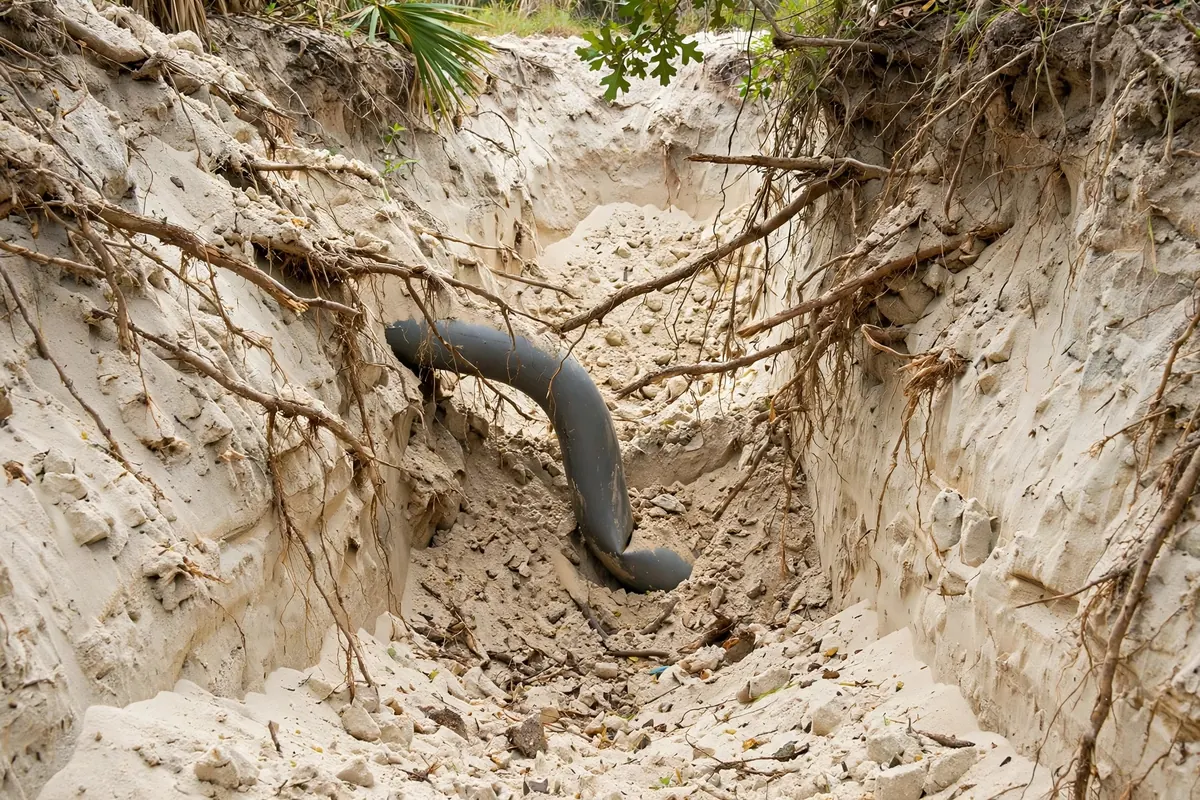
Sand Moves. Clay Doesn't (Much). That's the Whole Problem.
Soil types behave completely differently underground. Dense clay holds its shape for decades — dig a trench in clay and the walls stand. Sand flows. It shifts with groundwater movement, settles under load, washes out in heavy rain, and compacts unevenly. A sewer lateral bedded in sand is riding on a foundation that never fully sits still.
This matters because sewer pipes are rigid systems that depend on uniform support. When the ground beneath a section of pipe settles even an inch or two more than the sections around it, the pipe follows — and now you have a belly, a low spot where the grade is lost. Wastewater slows there. Solids settle there. What started as a soil issue becomes a pipe issue becomes a backup issue.
Bellies: The Signature Florida Sewer Failure
A belly (pipers also call it a sag) is a section of pipe that's lost its downhill slope. Sewer lines work on gravity — typically a quarter-inch of fall per foot. Lose that grade in one section and solids drop out of the flow and accumulate, like sediment in a slow river bend.
Bellies are the single most Florida-specific sewer defect. In clay-soil states, they're relatively rare; here, they're routine findings on camera inspections, especially in newer subdivisions where backfill around the pipe wasn't compacted in proper lifts during construction. The pipe was installed perfectly straight — then the ground moved and took it along.
The cruel part: bellies can't be fixed trenchless. Lining the inside of a sag just gives you a nicely lined sag. Correcting grade means excavation. This is why proper initial compaction matters so much — and why "the pipe is new" isn't the same as "the pipe is fine" in sandy ground.
Offset Joints: Death by a Thousand Shifts
Older pipes — clay tile especially — come in segments joined every few feet. Each joint is a hinge point. When sandy soil settles unevenly, segments shift relative to each other: one drops a half-inch, another tilts. The result is an offset joint — a lip inside the pipe that catches toilet paper, wipes, and solids.
A single offset might just slow things down. But clay laterals have joints every 3–4 feet, which means dozens of potential offset points along a single lateral. In neighborhoods like Bayshore Gardens or Samoset, where 1950s–60s clay laterals have been riding shifting sand for 60+ years, camera inspections routinely show a staircase of small offsets — each one a snag point, together a chronic clog machine.
Roots love offset joints too. The gap is an open door: moisture, nutrients, and an entry point, all in one. Soil movement opens the door; roots walk through it. The two Florida failure modes feed each other.
The Water Table Makes Everything Worse
Manatee County's water table sits high — a few feet down in many areas, practically at the surface near the rivers, bays, and barrier islands. A sewer lateral in high groundwater lives a harder life in three ways.
- Infiltration. Groundwater pushes into the pipe through every crack, gap, and bad joint. This extra water overwhelms the line's capacity during storms and carries fine sand in with it — sand that then settles in bellies and accelerates wear.
- Buoyancy and bedding loss. Saturated sand loses its ability to support the pipe uniformly. Sections can settle differentially as groundwater rises and falls with seasons and storms.
- Exterior corrosion. Metal pipes sitting in constant moisture corrode from the outside too, not just from the wastewater inside. Cast iron laterals in low-lying areas get attacked on both faces.
This is also why heavy rain events cause backups even in "working" systems — infiltration can multiply the flow in a lateral several times over, exceeding what the pipe was sized to carry.
Construction and Compaction: The Human Factor
Not all soil damage is natural. How the trench was backfilled when the pipe went in determines how it behaves for the next 50 years. Proper practice: bedding material under the pipe, backfill placed in thin compacted lifts, no large rocks against the pipe. Rushed practice: push the sand back in, drive over it once, move on.
In fast-growing areas like Lakewood Ranch and Parrish, where whole subdivisions rose in a few years, installation quality varies by builder and crew. A bellied PVC lateral in a 10-year-old home is almost always a compaction story, not a material story. This is worth knowing because it means even newer homes aren't immune — the soil doesn't care how old the pipe is.
What You Can Actually Do About It
You can't change your soil. But you can work with it:
- Get a baseline camera inspection if your home is 20+ years old or you've never had one. Knowing whether you have bellies, offsets, or clean pipe changes every decision downstream.
- Don't ignore slow drains. In sandy soil, "a little slow" is often a belly collecting solids — the earliest, cheapest stage to intervene.
- Keep roots out of the equation. Roots exploit exactly the joints that soil movement opens. Root management and soil-movement awareness go together here.
- If you're building or replacing, insist on proper bedding and compacted backfill — and on a post-installation camera inspection proving the grade is correct before anyone backfills the trench. This single step prevents the most common Florida sewer defect there is.
The ground beneath Bradenton isn't going to stop moving. But a pipe installed right, inspected periodically, and repaired with the soil in mind can outlast the house above it. Work with the sand instead of pretending it isn't there.
How to Tell If Soil Movement Is Your Problem
You can't see underground, but soil movement leaves surface clues along the lateral's path:
- Depressions or dips in the lawn following a line from house to street — settling backfill or voids from soil washing into a broken pipe.
- Cracks in driveways, walkways, or patios that cross the pipe route — differential settling underneath.
- A cleanout that has sunk or tilted relative to the surrounding grade — the ground around it moved.
- Drainage that worsens gradually over years rather than suddenly — the signature of slow settling, not a sudden blockage.
- Gurgling that correlates with heavy rain — infiltration through movement-opened joints, worse when the water table rises.
Any of these plus an older home is a strong candidate for a camera inspection. The footage will show bellies and offsets directly — soil movement has a distinctive look underground, a gentle sagging staircase that's unmistakable once you've seen it.
Buying a Home? Read the Soil, Not Just the Inspection
If you're house-hunting in Manatee County, add soil awareness to your checklist. Ask the seller's disclosure about any sewer work history. Look at the yard for the settling clues above. And seriously consider a pre-purchase sewer inspection — in sandy-soil Florida, it's the only way to know whether the lateral held its grade or slowly sagged into a belly farm over the decades. The general home inspector won't check; the camera will.
For new construction, ask the builder about compaction and bedding practices — and get an independent camera inspection before closing. A pipe installed last year with a belly from rushed backfill is a warranty claim waiting to happen, but only if you catch it while the builder is still on the hook.
Need help with your sewer line?
We serve Bradenton and all of Manatee County. A camera inspection is the fastest way to know what's going on.
Call (941) 214-9486